

Table of Contents
- Why Finding a Reputable Dog Rescue Matters
- How to Verify a Dog Rescue Nonprofit
- Questions to Ask a Dog Rescue Before Adopting
- Dog Rescue Red Flags to Watch For
- What to Expect in a Dog Adoption Contract
- How to Compare Reputable Dog Rescues Beyond Star Ratings
- Supporting Reputable Dog Rescues After Adoption
- Conclusion: Your Role in Responsible Adoption
- Frequently Asked Questions
Last Updated: October 10, 2026
Why Finding a Reputable Dog Rescue Matters
Finding a reputable dog rescue is the most important step in bringing home a dog you can trust.
Dogs placed by careful, foster-based rescues settle into new homes more smoothly than dogs moved through quick handoffs.
A polished website and cute photos tell you almost nothing. What matters is paperwork, transparency, and how the rescue answers hard questions.
What Sets Reputable Rescues Apart
Reputable rescues are open books: they show medical records, explain their adoption process, and let you meet the dog more than once. The clearest sign is a home visit or detailed phone screen covering your yard, kids, and other pets.
Look for these traits:
- A registered nonprofit organization with a real address
- A foster-based rescue model, not a warehouse of kennels
- Veterinary records and up-to-date vaccinations
How to Verify a Dog Rescue Nonprofit
Verifying a rescue's nonprofit status is the fastest way to separate a real organization from a fundraising page with a logo.
Start with the rescue's legal name, not the name on the website or social media. Many operate under a short marketing name while their registered entity is something like "Second Chance Canine Rescue of [County], Inc." Ask directly: "What is your registered legal name and EIN?"
Checking 501(c)(3) Status and Charity Registration
In the United States, a genuine rescue usually holds 501(c)(3) status from the IRS. You can confirm this through the IRS Tax Exempt Organization Search. Search the legal name and confirm three things: the status is active, the address matches the rescue's public address, and the mission relates to animal welfare.
Outside the US, use the local equivalent:
- Canada: Canada Revenue Agency charity list
- UK: Charity Commission register
- Australia: ACNC Charity Register
What to confirm on any registry:
- The legal name matches the donation page and adoption contract
- The registration is active, not revoked or delinquent
- The stated mission involves animal welfare
Checking State Registration and Solicitation Licenses
Federal tax status is not the whole picture. Many US states require charities that solicit donations to register with the state attorney general or a charity regulator.
Look for:
- A state charity registration number on the donation page
- A solicitation license if your state requires one
- A physical address in the state where it operates
If a rescue claims nonprofit status but cannot produce a registration number, treat that as a serious warning. Some groups use the word "rescue" with no formal nonprofit status, meaning your donation is not tax-deductible and there is no public record of how funds are used.
Verifying Donation Claims
A trustworthy rescue can explain where donations go. Ask:
- What percentage of donations goes to animal care versus administration?
- Can you see a recent annual report or Form 990?
- Are donations tax-deductible, and what is the EIN for your records?
Form 990 filings are public for most US 501(c)(3) organizations and show revenue, expenses, and program spending. A refusal to share financial information is a red flag, not proof of fraud, but a reason to slow down.
A Quick Verification Checklist
Use this before you donate or apply:
| Check | Where to Confirm | What Good Looks Like |
|---|---|---|
| Legal name and EIN | Ask the rescue directly | Provided promptly |
| 501(c)(3) status | IRS Tax Exempt Organization Search | Active, mission matches |
| State charity registration | State attorney general or regulator | Number listed or explained |
| Physical address | Website, registry, Google Maps | Real location, not just a PO box |
| Financial transparency | Form 990 or annual report | Available on request |
| Contact responsiveness | Phone or email | Replies within a few days |
This step takes about ten minutes and protects you from fake operators and unaccountable groups.
Questions to Ask a Dog Rescue Before Adopting
Ask a dog rescue about health, behavior, fees, and its return policy before you commit. A trustworthy rescue welcomes these questions. A shady one gets defensive.
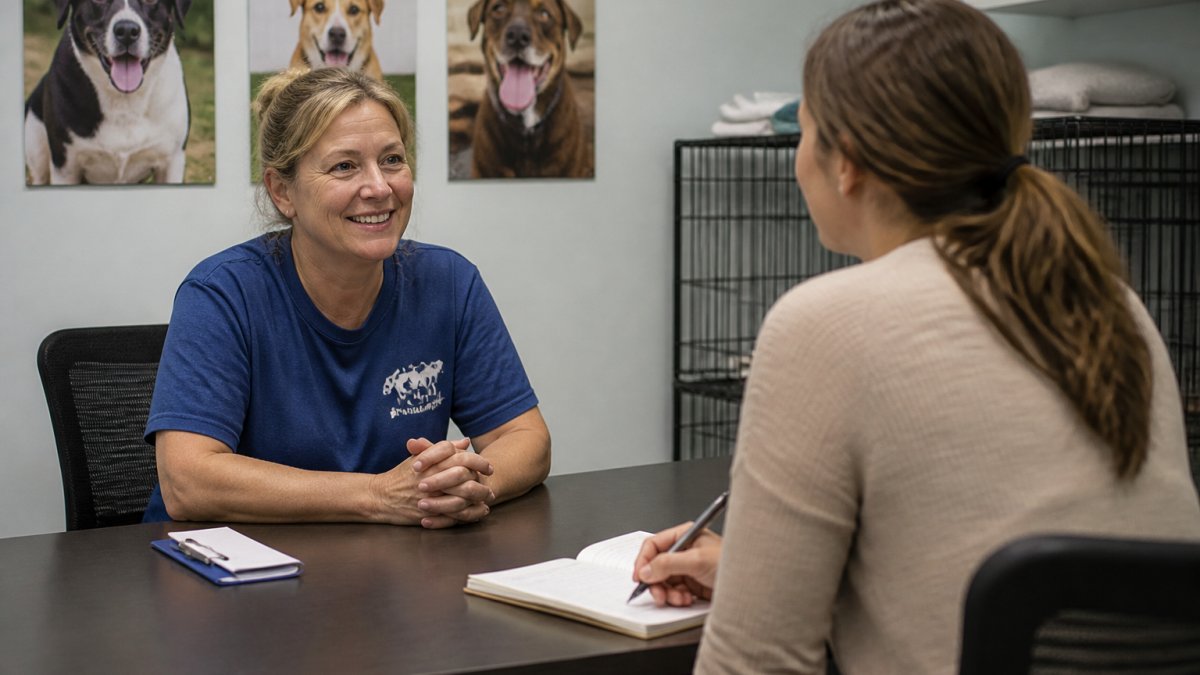
Bring a notepad. Write down the answers. This is your adoption application due diligence.
Key Questions About Health, Behavior, and Care
These questions reveal how well the rescue knows each dog.
- Has this dog seen a vet recently? Can I see the records?
- Is the dog spayed or neutered? If not, when will that happen?
- What vaccinations are current?
A rescue that says "we don't know" to everything is not doing its job. A good one has a behavior assessment on file.
Questions About the Adoption Process and Fees
The adoption fee should be explained clearly, line by line.
- What does the fee cover? (Vet care, vaccines, spay/neuter, microchip?)
- Is there a home visit or trial period?
- What is the return policy if the match fails?
Dog Rescue Red Flags to Watch For
Certain warning signs should stop you in your tracks. Knowing them protects your family and the dogs.
Watch for these dog rescue red flags:
Happiness Unleashed Adult Hoodie Sweatshirt - White Logo →
- No physical address or only a PO box
- Pressure to pay a deposit before meeting the dog
- Cash-only payments with no receipt
Scams use sad photos and urgent language to rush you. Real rescues never pressure you to decide in an hour.
What to Expect in a Dog Adoption Contract
A dog adoption contract is a legal agreement that protects the dog, the rescue, and you. Read every line before signing.
A fair contract covers:
- The adoption fee and what it includes
- A clause requiring spay and neuter if not already done
- The rescue's right to reclaim the dog if you can't keep it
Some contracts require you to contact the rescue first if you ever need to rehome the dog, this is normal and good, because it means the dog will never be abandoned. If a contract seems one-sided, ask questions; a reputable rescue will explain its reasoning.
How to Compare Reputable Dog Rescues Beyond Star Ratings
Star ratings help, but they miss a lot. A rescue with hundreds of five-star reviews can still be disorganized, evasive about medical history, or quick to place dogs without screening, while a small foster-based rescue with a dozen reviews may be far more careful. Compare rescues on transparency, follow-through, and how they handle the hard parts of adoption.
Why Star Ratings Are a Starting Point, Not a Verdict
Reviews are useful for spotting patterns, but they are easy to game and misread:
- A cluster of five-star reviews posted in the same week may be solicited or fake.
- A single angry review may reflect a rejected application rather than a bad rescue.
- Reviews rarely mention medical records, return policies, or post-adoption support.
Read the middle reviews, the three- and four-star ones, because they often describe the actual experience. Look for repeated complaints about communication, health disclosures, or pressure to adopt.
A Practical Comparison Framework
When weighing two or more rescues, score each on the same criteria so you are not swayed by a nicer website or a sadder story.
| What to Check | Why It Matters | How to Confirm |
|---|---|---|
| Nonprofit status | Proves legitimacy | Charity registry search |
| Medical records | Shows real vet care | Ask to see them |
| Foster-based model | Dogs know home life | Ask where dogs live |
| Return policy | Protects the dog | Read the contract |
| Behavior assessment | Reduces surprise issues | Ask what was evaluated |
| Post-adoption support | Helps you keep the dog | Ask what is offered |
| Reviews and ratings | Shows real experiences | Read recent middle reviews |
| Contact information | Proves they're reachable | Call the number |
A rescue with a few honest reviews and full transparency beats one with hundreds of reviews and no paperwork every time.
Questions That Reveal How a Rescue Operates
Ask the same questions of every rescue and compare answers side by side:
- How many dogs did you place last year, and how many were returned?
- What happens if the adoption does not work out?
- Who pays for vet care if a health issue appears in the first 30 days?
A rescue that answers clearly is likely to be honest later; one that deflects is showing you how it will behave after you sign.
How to Verify Claims Independently
Do not rely only on what the rescue tells you. Cross-check:
- Call the vet clinic listed on the medical records to confirm the dog was seen there.
- Search the rescue's legal name in your state's charity registry.
- Check whether the rescue appears on any local animal welfare coalition or shelter partner list.
This is not about being suspicious of every rescue. It is about confirming that the story you are being told matches the public record.
Weighing Trade-Offs
No rescue is perfect. You may have to choose between a larger rescue with more dogs but less individual attention and a smaller foster rescue with fewer dogs but more detailed history. If you have children or other pets, prioritize rescues that do detailed behavior assessments and home visits. If you are experienced with dogs, a leaner process is fine, as long as the medical records and contract are solid.
Supporting Reputable Dog Rescues After Adoption
Adoption is the start, not the finish. Rescues rely on ongoing community support to keep helping dogs:
- Donations of money, food, or supplies
- Volunteer opportunities at events or in foster homes
- Sharing adoptable dogs on social media
At Island Dogs, we donate 15% of net proceeds to local groups that help dogs find loving homes. Our Happiness Unleashed Adult Hoodie Sweatshirt - Navy Logo is made from an 80% cotton, 20% polyester blend fleece with a jersey-lined hood.

For warmer days, the Happiness Unleashed Adult Short Sleeve Tee - White Logo is a soft, pre-shrunk tee with a regular fit. Every purchase helps fund dog placement and care.

Every bit of support keeps forever homes within reach for more dogs.
Conclusion: Your Role in Responsible Adoption
Finding a reputable dog rescue takes a little homework, but it pays off in a dog you can trust for life. Check the registration, ask the hard questions, and read the contract.
When you're ready to celebrate that bond, Island Dogs is here. Our apparel and wall art honor the joy rescue dogs bring, and every purchase donates 15% of net proceeds to local organizations helping dogs find loving homes.
Frequently Asked Questions
How can I tell if a dog rescue is reputable?
Check for 501(c)(3) status, transparent adoption processes, and a willingness to answer questions. Reputable dog rescues provide veterinary records, allow meet-and-greets, and have a clear adoption contract. Look for reviews and ratings from local communities, and verify their nonprofit registration. Avoid rescues that pressure you or lack transparency about fees and medical care.
What questions should I ask a dog rescue before adopting?
Ask about the dog's medical history, vaccinations, spay/neuter status, and behavior assessments. Inquire about the adoption fee and what it covers, the return policy, and how they support adopters post-adoption. Also ask how they handle foster homes and whether you can speak with current foster volunteers. These questions help you gauge the rescue's standards of care and transparency.
What are red flags when adopting a dog from a rescue?
Red flags include refusal to provide veterinary records, no adoption contract, pressure to pay cash without receipts, and reluctance to let you meet the dog before adopting. Also be wary if the rescue cannot verify its nonprofit status or if reviews mention poor communication. Trust your instincts: a reputable dog rescue welcomes questions and prioritizes the dog's welfare over quick placements.
How do I verify a dog rescue's nonprofit status?
Use the IRS Tax Exempt Organization Search or GuideStar to confirm 501(c)(3) status. Check your state's charity registration database for additional verification. Reputable dog rescues will readily provide their EIN and registration details. You can also look for transparency in their annual reports and how they allocate donations to medical care, foster homes, and community support.