

Table of Contents
- Assess Your Space Before Selecting Dog Art
- Dog Wall Art for Small Spaces: Size and Scale
- Dog Art Print Sizes and Placement Strategies
- Small Apartment Wall Art Ideas That Complement Your Décor
- Gallery Wall Ideas for Dog Lovers in Compact Rooms
- Select Dog Art That Reflects Your Rescue Mission
- Pet-Safe Installation for Renters and Apartments
- Frequently Asked Questions
Last Updated: October 10, 2026
Assess Your Space Before Selecting Dog Art
Measure your space before buying. The wall you choose, its light, and existing décor determine whether dog art small apartment selections enhance or cramp your space.
Identify focal points: walls behind sofas, above console tables, or near entryways. These spots naturally draw the eye and suit dog wall art.
Measure your walls and identify focal points
Measure wall width (typically 8-12 feet) and height (8-9 feet). You'll use these to calculate the right art size.
Consider lighting and wall condition in rentals
Place dog art in areas with consistent, indirect light. Direct sunlight fades portraits; dim corners make them disappear.
For renters, check wall condition. Textured walls make damage-free hanging tricky; consider freestanding easels or leaning frames instead.
Dog Wall Art for Small Spaces: Size and Scale
The biggest mistakes: art too small (looks lost) or too large (overwhelms the room). Use a simple formula tied to furniture and wall dimensions.
The furniture-width rule for art sizing
Your dog art should be 50-75% of the furniture width below it. This is the most reliable sizing method for small spaces.
Examples: 6-foot sofa → 36-54" art; 4-foot console → 24-36" art; 3-foot dresser → 18-27" art. This ratio anchors the art without overwhelming it.
Translating wall dimensions into frame sizes
For walls without furniture, art width should occupy 40-60% of wall width.
Common sizes: 6'×8' wall → 24"×36" art; 8'×9' wall → 30"×40" art; 10'×9' wall → 36"×48" art; hallway → 12"×18" art.
Single portraits versus multiple pieces
One large dog portrait creates a clean focal point. Multiple pieces demand careful spacing to avoid clutter in tight rooms.
Choose a single portrait for apartments under 700 sq ft or busy walls. Choose a gallery wall for dedicated, isolated walls (hallways, bedrooms) with 8+ feet of width.
Dog Art Print Sizes and Placement Strategies
Hanging height and distance from furniture
Hang dog art at eye level (57-60 inches from floor to center). Maintain 8-12 inches above furniture and 12-18 inches from adjacent walls. Distance matters in small rooms.
Corner and nook placement for tight spaces
Corner nooks are perfect for dog art. They define space without requiring wall real estate and work for reading nooks, alcoves, hallways, and areas between windows.
Small Apartment Wall Art Ideas That Complement Your Décor
Your dog art small apartment choices should feel like they belong in your space, not like something you hung as an afterthought. Match it to what's already there.
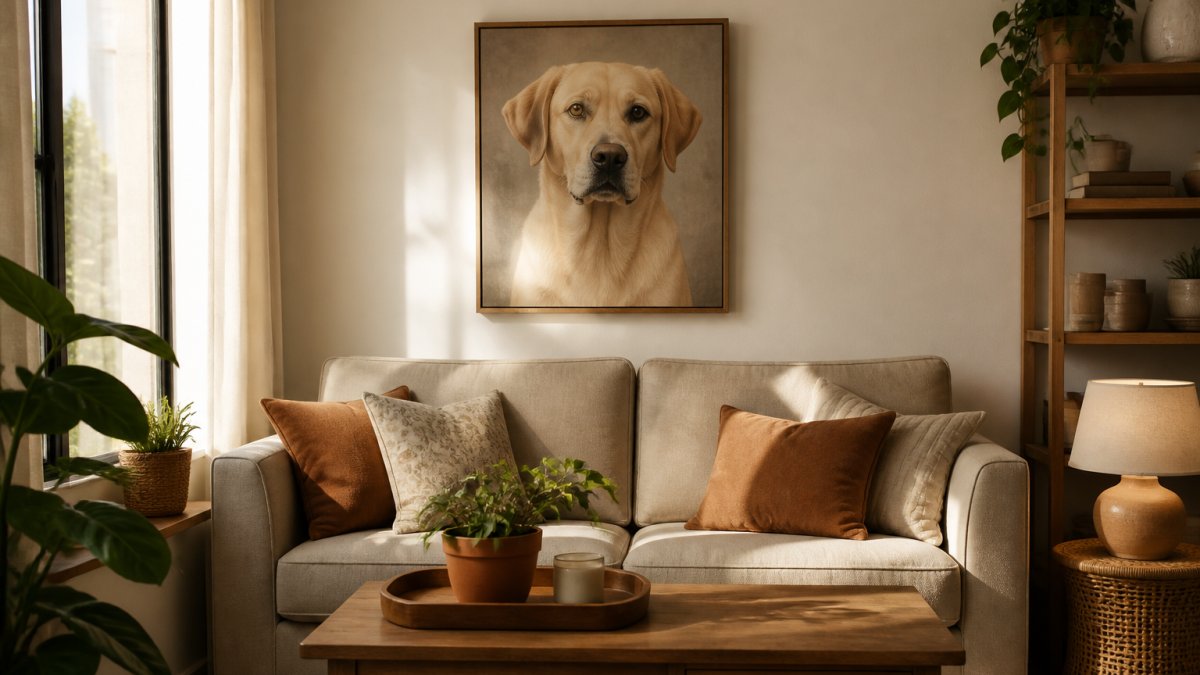
Matching art style to your color palette
Match dog art to your wall color: neutral walls work with any style; warm walls suit warm-toned portraits; cool walls suit cool-toned or black-and-white art.
At Island Dogs, we understand that your dog art reflects your values. Our collection celebrates rescue dogs through thoughtful design that fits your home's aesthetic while supporting local animal organizations through 15% of net proceeds donated to dog rescue programs.
Choosing frames that enhance small rooms
Use thin, light-colored frames in small apartments. They expand space visually and let the dog portrait breathe without competing for attention.
Gallery Wall Ideas for Dog Lovers in Compact Rooms
Deciding between single, diptych, triptych, and grid formats
Choose a format based on wall size, number of dogs, and visual preference:
Single portrait: Best for walls under 8 feet, apartments under 700 sq ft. Diptych (2 pieces): Best for 8-10 foot walls, two dogs. Triptych (3 pieces): Best for 10-12 foot walls, three dogs. Grid wall (4+ pieces): Best for dedicated walls only; avoid in small apartments unless isolated.
Planning layout to avoid visual clutter
Start on paper before you hang anything. Sketch your wall to scale, marking furniture, windows, outlets, and light switches. Then arrange your dog art pieces on the floor first. Move them around. Find the arrangement that feels balanced before you hang a single nail.
Use these principles:
- Maintain consistent spacing: Leave 2-4 inches between all frames. Measure and mark with painter's tape before hanging.
- Choose a dominant pattern: Arrange by height (tallest in center, shorter on sides), create a grid (all frames same size), or use a symmetrical layout (mirror images on left and right).
- Balance visual weight: If frames are different sizes, place larger pieces toward the center or top. Smaller pieces fill gaps without creating imbalance.
- Keep the overall shape rectangular or square: Avoid scattered, asymmetrical arrangements in small spaces. They feel chaotic rather than intentional.
- Limit to 3-5 pieces maximum: More than five pieces fragments the visual space and creates clutter in compact rooms.
Spacing and symmetry in tight layouts
Symmetry calms small spaces. Asymmetry energizes them but risks feeling chaotic in compact rooms.
For small apartments, use symmetrical arrangements:
- Center-focused: Place a large dog portrait in the center with smaller pieces flanking it on left and right (diptych or triptych with a focal point)
- Grid pattern: Arrange pieces in a 2×2 or 2×3 grid with all frames the same size and consistent spacing
- Vertical line: Arrange pieces in a vertical column down the center of the wall (works for narrow walls or hallways)
These patterns feel intentional. They make small spaces feel organized rather than crowded. They also make installation easier because you can measure from a center point and work outward.
Renter-specific gallery wall installation
Gallery walls require multiple hanging points, which raises renter concerns. Use these damage-free methods:
- Command picture hanging strips: Available in various weight ratings (up to 16 lbs per strip). For a 2×2 grid, use one strip per frame. They remove cleanly without wall damage.
- Painter's tape for layout: Before hanging, use painter's tape to outline each frame on the wall. This lets you visualize the layout and adjust spacing without making holes.
- Stud finder (optional): If you want to use nails instead of strips, locate studs with a stud finder and use small finishing nails. Fill holes with paintable caulk when you move out.
- Freestanding easels or leaning frames: For renters who want to avoid wall damage entirely, arrange multiple frames on a console table, dresser, or floating shelf instead of hanging them.
Gallery walls in small apartments work best when they're intentional, symmetrical, and limited in scope. A well-planned diptych or triptych tells your rescue dog's story without overwhelming your space.
Select Dog Art That Reflects Your Rescue Mission
Your dog art tells a story. It honors your rescue dog. It celebrates the bond you share. Choose art that means something.
Breed-specific portraits and mixed-breed celebrations
Breed-specific portraits capture your dog's unique personality. A Golden Retriever portrait looks different from a shelter mix. The breed matters because it's part of your dog's identity.
If you adopted a mixed breed, that's your story to celebrate. Many dog lovers cherish mixed-breed portraits because they represent rescue. Your dog's mixed heritage is beautiful. It's real. It's worth honoring.
Island Dogs specializes in dog wall art that captures these stories. Our pieces celebrate rescue dogs in all their forms, helping you create a space that reflects your commitment to animal welfare while supporting organizations that help dogs find loving homes.
Choosing meaningful styles that tell your story
Consider these art styles:
- Realistic portraits: True-to-life representations of your dog
- Watercolor: Soft, emotional, dreamy quality
- Line art: Minimalist, modern, clean
- Pop art: Bold, colorful, energetic
The style should match how you feel about your dog. A rescue dog who's finally found peace might suit a calm watercolor. A boisterous, playful rescue might shine in bold pop art.
Your dog's story matters. Your art should reflect it.
Pet-Safe Installation for Renters and Apartments
How you hang dog art matters. In rentals, damage-free methods are essential. With active dogs, stability is crucial.
Damage-free hanging methods
Use these renter-friendly options:
- Command strips (removable adhesive hooks)
- Picture hanging strips rated for your frame weight
- Magnetic strips (if walls allow)
- Freestanding easels or leaning frames
Command strips work on most apartment walls. They hold frames up to 16 pounds. They remove cleanly without damage. This is the renter's best friend.
For heavier pieces, use picture hanging strips specifically designed for your frame weight. Read the weight limits carefully.
Materials that work with active dogs
Active dogs jump. They play. They accidentally bump walls. Your dog art needs to be stable and safe.
Choose:
- Frames with secure glass or acrylic (not loose)
- Heavy-duty hanging hardware
- Secured frames (not leaning pieces that could fall)
- Stable frames that won't tip if nudged
Never hang glass frames low enough for a dog to knock them down. Keep dog art above jump height. Most dogs can't reach higher than 5 feet.
Choosing dog art for a small apartment is about balance. You're honoring your rescue dog while respecting your space. Measure thoughtfully. Choose meaningful pieces. Install them safely.
At Island Dogs, we believe your home should reflect your values. Our dog wall art celebrates rescue dogs and human-dog connections.
Frequently Asked Questions
What size dog art works best in a small apartment?
For small apartments, a single portrait typically works best between 16x20 inches and 24x30 inches, depending on wall space and viewing distance. As a rule, artwork should occupy 50-75% of the wall space above furniture. Larger pieces (36+ inches) can work if your walls are bare, but multiple smaller pieces (8x10 to 11x14 inches) often feel less cramped in compact rooms. Measure your wall first and hold up a piece of paper to visualize scale before committing.
How do you choose dog art that matches your apartment decor?
Start with your room's existing color palette. If walls are neutral, choose dog art with warm or cool tones that complement your furniture. Consider your interior style: modern apartments suit minimalist line portraits, while cozy spaces work well with colorful or traditional breeds. Match frame finishes to existing décor elements like door frames or shelving. Subtle, muted tones prevent visual clutter in small spaces, while bold colors work as statement pieces if you have minimal other décor.
Can I display multiple dog prints in a small apartment without making it feel cluttered?
Yes, with careful planning. Gallery walls work in small spaces when pieces are tightly grouped with consistent spacing (2-3 inches between frames). Limit your gallery to one wall section rather than spreading pieces across the room. Use matching or coordinating frames to create visual unity. Keep the total gallery footprint smaller than a single large portrait would be. Arrange pieces on paper on the floor first to test the layout, ensuring balanced distribution of dog portraits, breed variety, and empty space.
Is dog art from Island Dogs worth the investment for a rental apartment?
Island Dogs dog art is designed to celebrate your bond with rescue dogs while supporting local animal welfare organizations through 15% of net proceeds. For renters, the value extends beyond decoration: you're investing in a piece that moves with you to future homes and supports a meaningful mission. The quality and thoughtful design justify the investment if you're committed to displaying it. Even if you're in a temporary space, dog art that reflects your rescue dog passion creates a cozy, finished atmosphere that makes any apartment feel like home.